
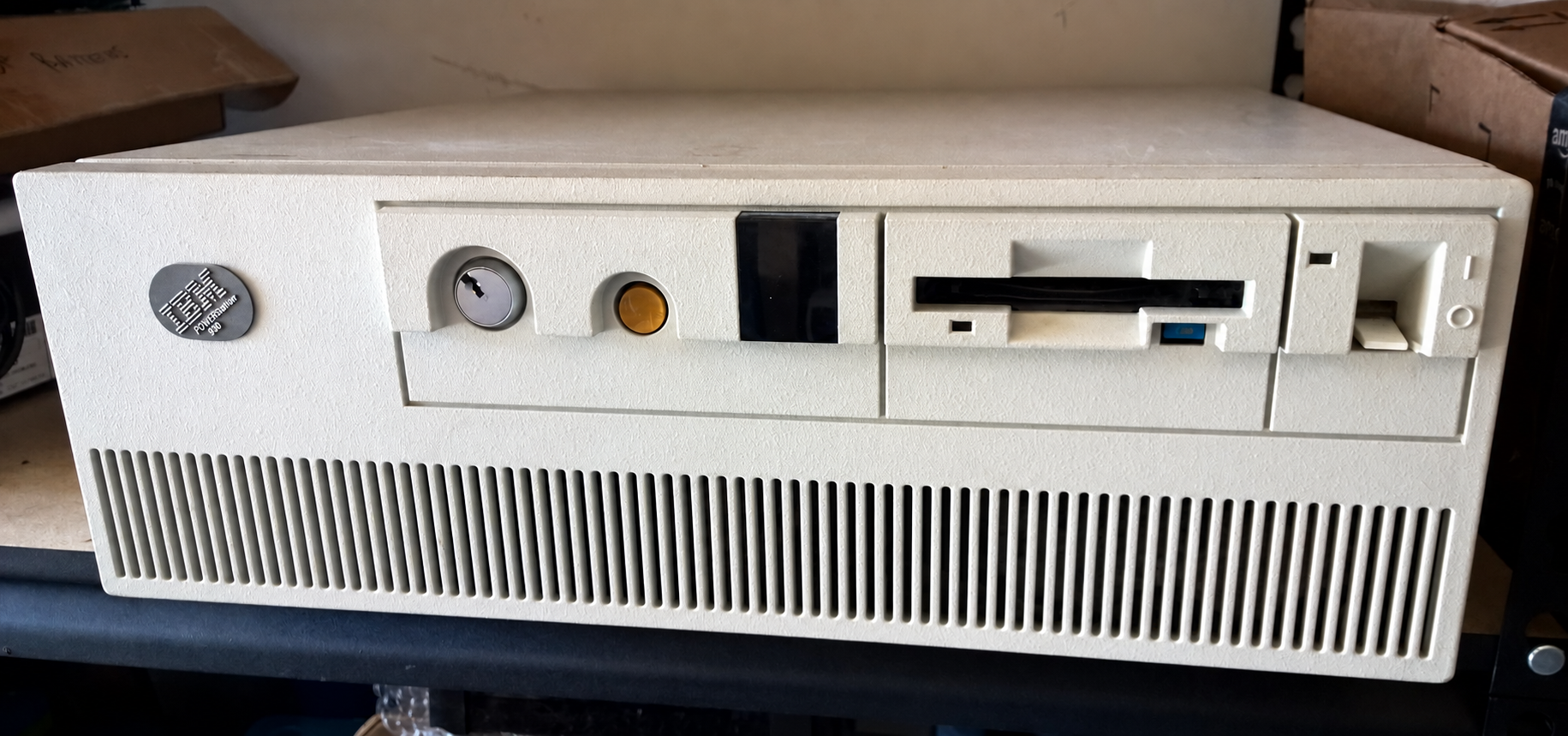
IBM POWERstation 320
An IBM RISC System/6000 workstation built around AIX.
The POWERstation 320 was IBM’s entry desktop workstation for the RISC System/6000 family. It brought the POWER architecture and AIX, IBM’s Unix, into a compact system intended for serious technical work.
Its history runs through Austin. IBM’s RISC effort was organized there under Andy Heller, one of the engineers who helped turn the POWER design into a product line. The 320 is a quiet-looking machine with a consequential role: it made IBM’s Unix workstation architecture available at an engineer’s desk, with AIXwindows, a C compiler, SMIT, and network services close at hand.
Contemporary AIX documentation describes the 320 as the workstation form of the same family that could also be sold as a POWERserver. That dual identity is part of what makes the object interesting: the box belongs equally to the history of Unix workstations and to IBM’s movement from mainframe-centered computing toward RISC systems.
All photographs of this object
IBM POWERstation 320
| Maker | IBM |
|---|---|
| Line | RISC System/6000 |
| Introduced | 1990 |
| Notable | POWER1 RISC processor, AIX, Micro Channel architecture |
| Front panel | Desktop POWERstation enclosure with removable media and status controls |
The POWERstation 320 made IBM’s POWER architecture available in a desktop workstation. AIX supplied the Unix environment, while AIXwindows, the C compiler, SMIT, and network services gave the machine the character of a complete engineering system rather than a bare processor box.
Record & provenance
The POWERstation 320 belongs to IBM’s first RISC workstation generation. Developed as part of IBM’s Austin-centered RISC effort, it brought the POWER architecture and AIX Unix to a desktop-sized system.
Reference: ATX-OBJ-IBM-PS2-DESKTOP
Source: collection inventory, photographs, and notes accompanying Serious Machines (Amir Husain, 2024).