
Tech Greats of Austin
Computers are made by people. Austin’s story runs through laboratories, dorm rooms, game studios, and the networks that joined them.
A city of builders
This collection brings together machines and the people whose ideas gave them purpose. James Truchard, Michael Dell, Richard Garriott, and Bob Metcalfe connect four large changes in computing: instruments shaped by software, PCs built around the buyer, worlds created inside a computer, and machines joined by a common network.
Amir Husain knows these builders personally. This gallery connects that relationship with the objects: a signed NI advertisement, personal computers, game development workstations, and networked Unix systems. Each gives us a way into the larger history through something that can be examined closely.
Dr. James Truchard
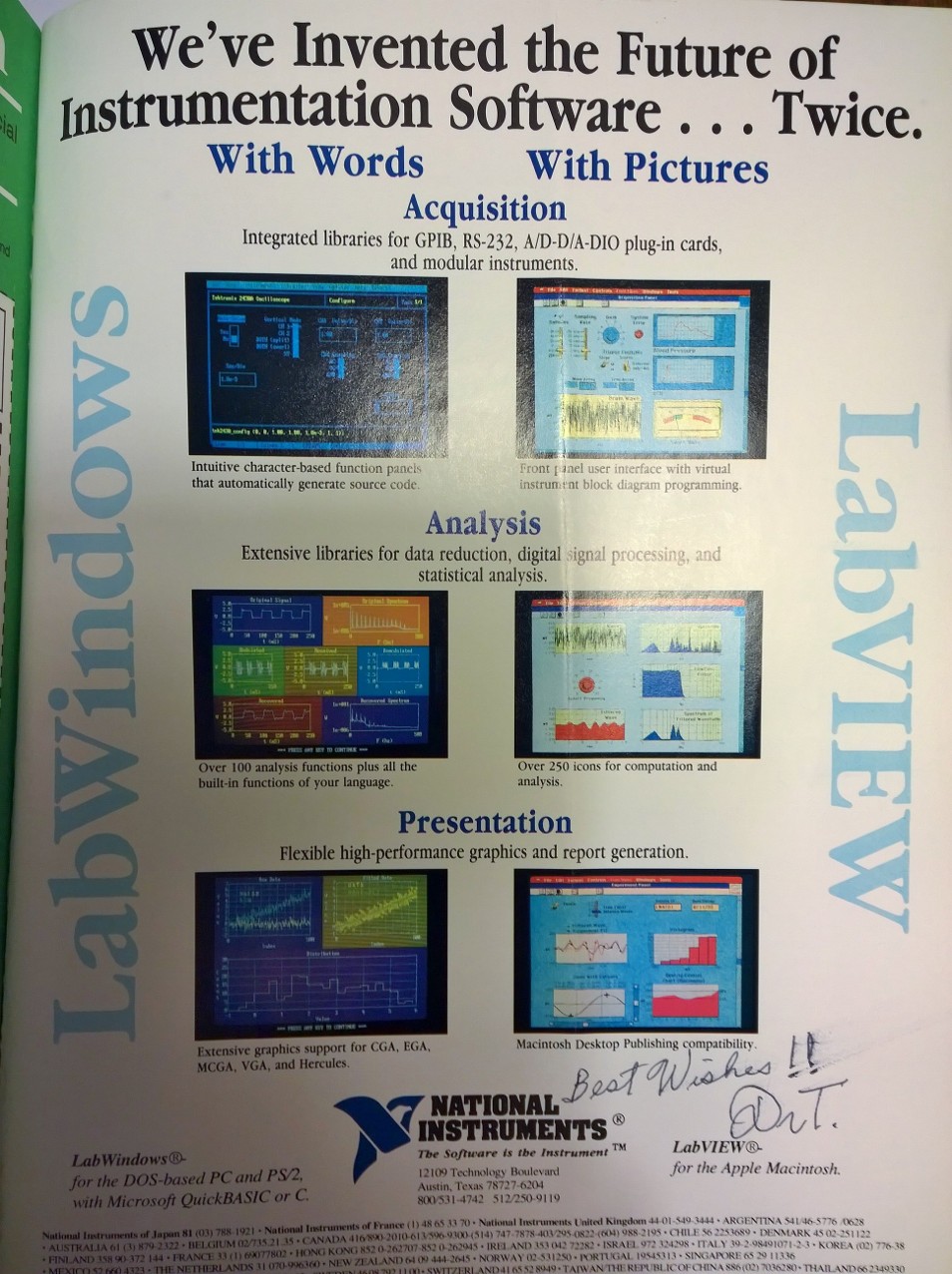
The advertisement places two approaches side by side: LabWindows and LabVIEW, words and pictures. Under both sit the same tasks: acquisition, analysis, and presentation. That is the argument in miniature. A computer could gather measurements, process them, and become the front panel of an instrument.
James Truchard founded National Instruments in Austin in 1976 with Jeff Kodosky and Bill Nowlin. Their work helped move laboratory computing from dedicated boxes with fixed controls toward instruments whose behavior could be shaped in software. A graph on a screen could sit at the end of a real electrical signal, bringing an experiment into the same environment used to analyze it.
Truchard’s inscription gives this printed page a personal history. It also offers a useful way to look at the museum’s HP engineering systems: follow the interface cable from an instrument into a computer, then follow the measurement into software. The connection is where the story happens.
Explore HP’s engineering workstation → · NI’s founding history
Michael Dell
Michael Dell founded PC’s Limited in 1984 while a student at the University of Texas. His opening was in the relationship between the machine and its customer: configure the computer people wanted and sell it directly to them. Standard parts made the hardware possible; assembly, ordering, and distribution made the business distinctive.
The collection’s Dell machines belong to the long expansion of that idea. A portable such as the Inspiron 7500 takes the compatible PC into another setting, giving its owner a familiar software environment away from the desktop. Austin’s influence on computing includes the practical systems that brought machines into everyday use at enormous scale.
Follow that question of access to Sirius, whose $50 goal required its own reconsideration of components and assembly. The ambitions operated at very different scales, but both made the cost of reaching a user part of the design problem.
Richard Garriott
Richard Garriott’s Ultima games made the computer a place to inhabit. A map could contain towns, conversations, obligations, and consequences. The player’s choices could become the organizing principle of a world. Origin Systems helped make Austin a center of game development, carrying that ambition from individual adventures into the shared world of Ultima Online.
A home computer on a museum shelf can make those worlds look impossibly small. The memory and display budgets were real constraints. They also encouraged systems in which a few rules and symbols could suggest far more than the screen could show at once. That is part of the creative power of software: an imagined place grows in the relationship between the program and its player.
The Turok development workstations preserve another branch of Austin’s game history. Iguana and Origin were distinct studios, linked here by a city and by the business of turning computation into places people remember.
Bob Metcalfe
Bob Metcalfe’s 1973 Ethernet memo at Xerox PARC helped set out a way for computers to share a local communications medium. With collaborators including David Boggs, he helped turn that idea into a network that could connect the machines around a workplace. His later career brought that history into Austin’s university and entrepreneurial community.
Look behind a workstation and the network connection becomes part of its identity. A shared disk, a printer down the hall, an application on another machine: the working environment extended beyond the case. The museum’s SGI and Sun systems make that change tangible.
Interflex tells a complementary story at a different scale. Ethernet connected a room; UUCP let a machine exchange work across a telephone call. Together they show how useful computing grew through connections, even when those connections were intermittent.