↗
Silicon Graphics
 Computer MuseumCentral Texas
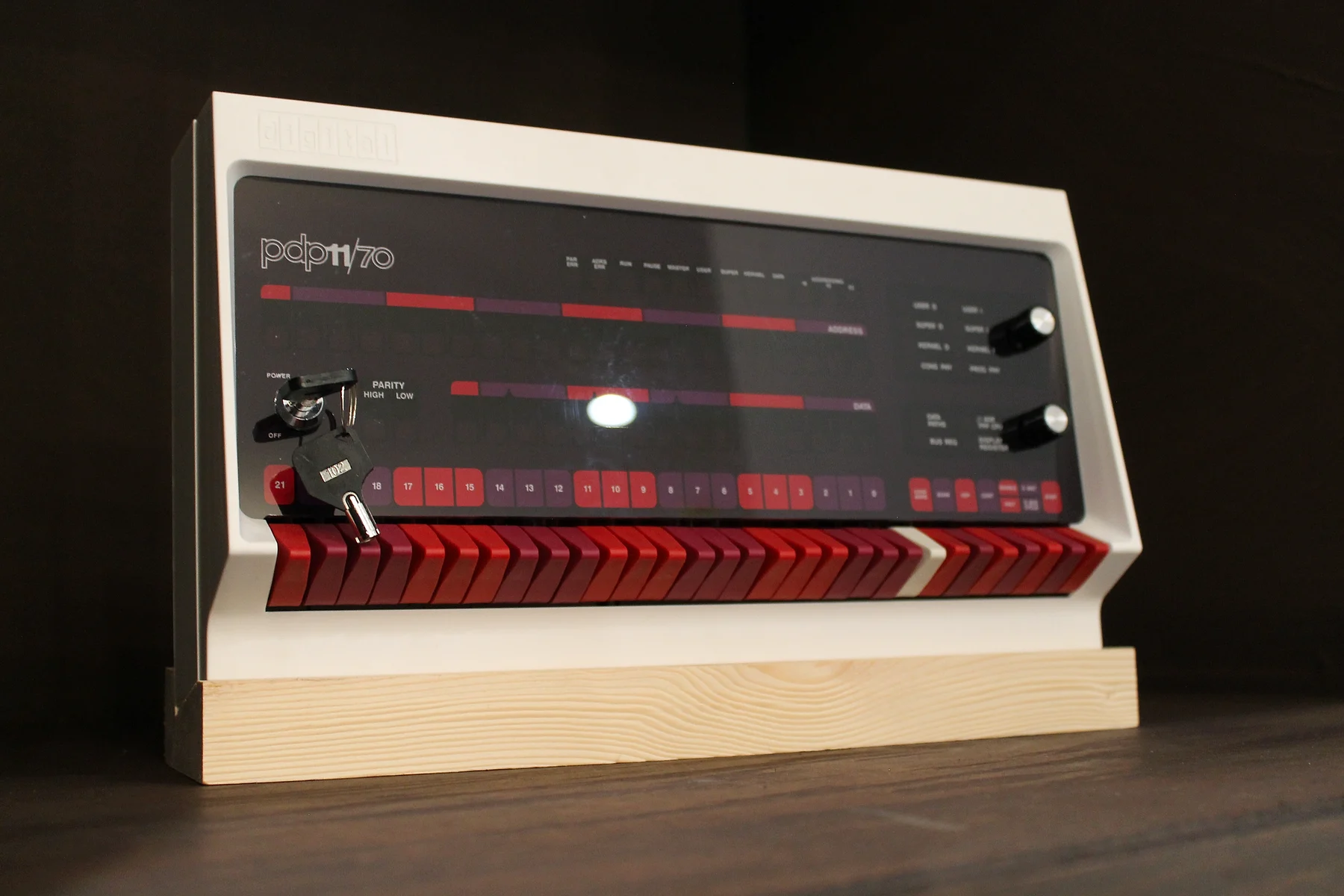
A working replica front panel for a PDP-11/70 computer.
This is a PiDP-11 replica front panel, built from the Obsolescence Guaranteed design. Its switches and lamps drive an emulated PDP-11/70; it is a working replica front panel for an emulated PDP-11/70. See the builder’s documentation for the replica design and software.
| Introduced | 1975 |
|---|---|
| Architecture | 16-bit minicomputer, PDP-11 family |
| Memory | Up to 4 MB through 22-bit addressing, with 2 KB cache |
| Buses | Unibus for peripherals, Massbus for fast storage |
| Console | Switch register and lamps, addresses and data in octal |
| Operating systems | RSX-11, RSTS/E, and Unix |
The 11/70 was the largest of the PDP-11s and the machine much of early Unix was written on and for. The panel is the interface: switches set an address, lamps show what is on the bus, and a running program is something you can watch. Its architecture, with peripherals addressed as memory rather than through special instructions, is the reason C treats a device register and a variable as the same kind of thing.
This is a PiDP-11 replica front panel, built from the Obsolescence Guaranteed design. Its switches and lamps drive an emulated PDP-11/70; it is a working replica front panel for an emulated PDP-11/70. See the builder’s documentation for the replica design and software.
Replica design and documentation at Obsolescence Guaranteed →
Reference: ATX-OBJ-060-IMG-5126
Source: collection inventory, photographs, and notes accompanying Serious Machines (Amir Husain, 2024).